John McKean · Rapid Transformation using Conversational Hypnosis · No scripts. No fluff. Just real change.
The Phoenix Method
Sport Performance Hypnosis

Find it. Clear it. Perform without it.
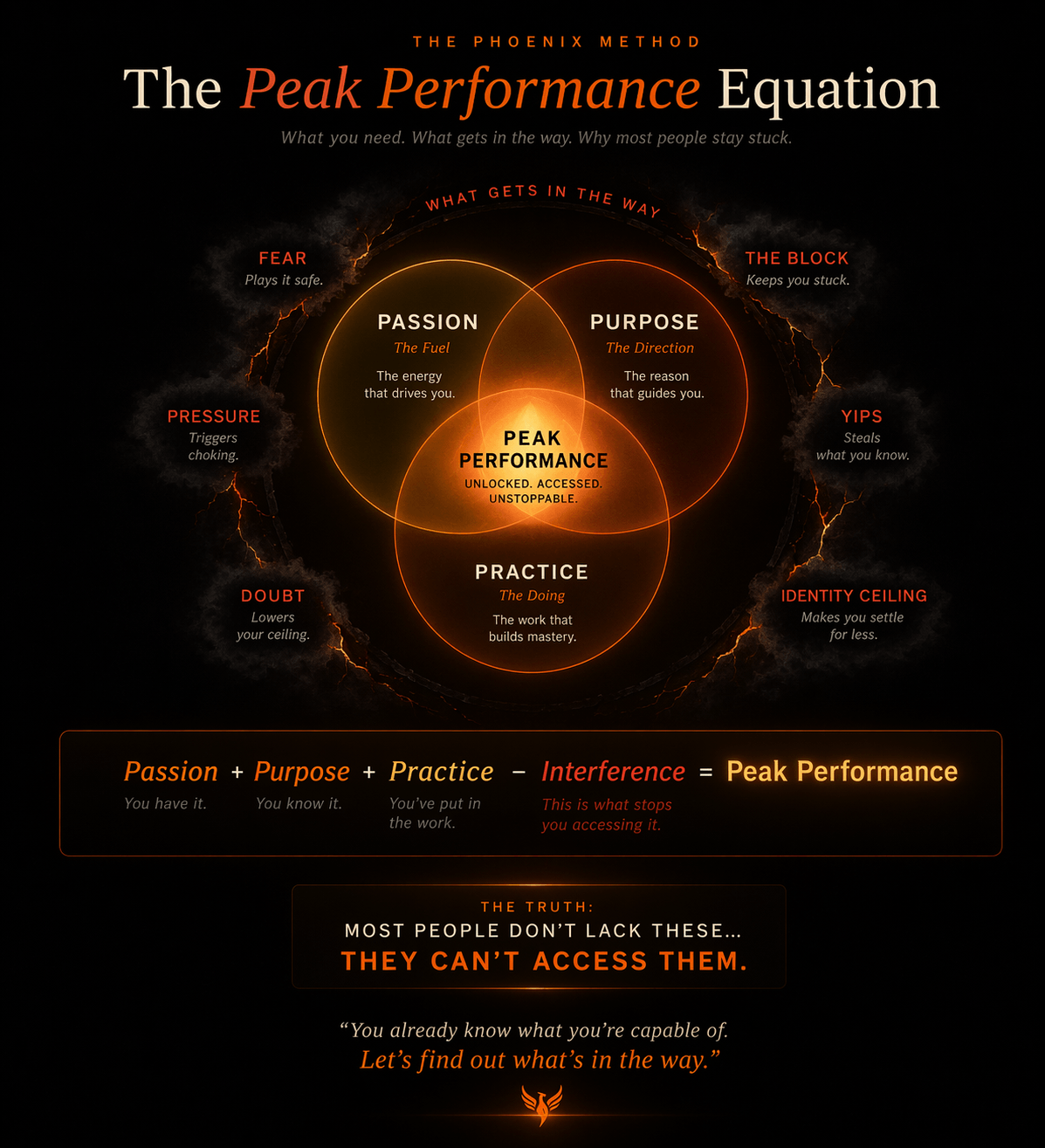
You already know what you’re capable of. The question is: what is stopping you accessing it when it matters?

RTT® · Advanced Conversational Hypnosis · Performance Mindset Coaching
The Real Problem
It is not always a skill problem.
You can train harder, analyse more, practise more, and still freeze, overthink, choke, avoid, or collapse under pressure. That is usually not a lack of ability. It is an internal response running underneath the surface.
The Phoenix Method looks at the past pattern affecting your present performance, then helps you build a stronger future identity.
The invisible opponent
It doesn't show up on the training ground. It shows up when it counts.
Every athlete knows what it's like to perform well in training and differently in competition. Most assume the gap is mental toughness, something to push through, to manage, to overcome with the right mindset routine.
It isn't. It's a protection response. Your unconscious mind has decided, at some specific point in the past, often with good reason at the time, that full performance in a high-exposure moment is dangerous. Not the sport. The exposure. Being watched. Being judged. The consequences of going all in and falling short in front of people.
So it pulls back. Consistently. Reliably. In every situation that resembles the original threat. That's not weakness. That's an opponent. And opponents can be beaten.
What's actually happening
The opponent you haven't beaten yet has been in the game longer than you have.
"It learned your patterns before you had the language for them. And it's been setting your ceiling ever since."
You've done the physical preparation. The conditioning is there. The technique is there. You've worked with coaches, watched the film, done the extra sessions. By every objective measure, you're ready. And yet, in the match, at the competition, in the moment with the highest stakes, something cuts in.
You go in half-hearted. The skill that works perfectly in training disappears under observation. The ceiling appears exactly when you need to break through it. The hesitation you can't explain and can't argue yourself out of.
That's not a preparation problem. That's not a mindset technique problem. That's a belief, formed at a specific moment, probably long before your current level of competition, that being fully seen in a high-stakes moment is unsafe. Your unconscious learned it. And it has been enforcing it ever since, regardless of how good you've become.
Visualisation, breathing techniques, positive self-talk, these work at the surface. They're managing the opponent, not defeating it.
RTT goes to where the opponent was created. Finds the moment. Changes the belief there. And the opponent stops showing up.
How the opponent shows up
You'll recognise at least
one of these.
The invisible opponent doesn't fight the same way twice. It finds the specific situation where your protection response is strongest, and that's the one it owns.
After the injury. When the body's healed and the opponent hasn't.
The physio says you're cleared. Physically, you are. But you still go in guarded. Half-committed. The opponent learned from the injury, it decided that full commitment equals danger, and it hasn't received the update that the threat has passed. The body healed. The belief didn't.
The ceiling that appears when you need the breakthrough.
In training you're a different athlete. In competition, in the moment with the most riding on it, you operate at 70% and you don't know why. The gap between what you can do and what you actually do when it counts. That gap is the opponent's work.
Going in half-hearted. Not because you want to.
You're present in body, absent in commitment. In contact sports this isn't just underperformance, it's more dangerous than going in fully. The opponent is trying to keep you safe by making you less safe. It doesn't care about the scoreboard. It cares about protection.
The yips. The opponent at its most precise.
A skill that's completely intact in private, gone the moment the audience appears. That's the opponent in its clearest form: it has linked performance under observation to threat, and it removes the skill to prevent the exposure. Not a technique failure. The opponent doing exactly what it was trained to do.
The opponent only shows up in specific situations.
Rough water. A particular type of opponent. A certain crowd or venue. The fear is contextual, present in one situation, absent in others. That precision tells you the opponent was created at a specific moment. Something specific was learned. Specific things can be unlearned.
Every technique helps. Nothing beats it.
You've tried visualisation, self-talk, breathing protocols, sports psychology sessions. They help at the margins. The opponent is still there at the centre. That's because every one of those approaches managed the opponent. None of them went to where it was built. That's the only place it can be beaten.
Athletes who beat it
They came in sceptical.
They left without the opponent.
Rugby · Athletic Performance · Age 18
Bobby
"Everything clicked. I was just pure, relaxed playing rugby. I was in my flow state."
Bobby's opponent was created on the pitch, the moment he damaged his shoulder in a tackle. Physically it healed. But the opponent learned something that day: that going in fully equals injury equals danger. And it started pulling him back in every tackle after that.
He started going in half-hearted. In rugby, that's actually more dangerous than committing fully. He felt like he was letting his teammates down, couldn't be relied on. His confidence dropped off the pitch too. He came in thinking this was going to be a waste of his time.
One RTT session. A 21-day recording listened to every night and before matches. The opponent didn't show up again.
Sessions
One RTT session
What changed after the opponent was cleared
Making more tackles on his previously injured shoulder than his good one
Teammates say they can rely on him again, and they tell him directly
Fully in his flow state, relaxed, present, fully committed
Came in sceptical. Left with both good shoulders and his confidence back.
Sea Kayaking · Performance Fear
Steve
"It solved an issue that had been affecting me for years."
Steve's opponent was the rough water. Experienced, technically capable, but the opponent showed up every time conditions got serious. It had been quietly limiting what water he'd go out in and how present he could be when he did, for years.
Two sessions before a six-day expedition in rough weather, the expedition he'd trained years to reach. The opponent didn't show. He was confident, comfortable, and fully present throughout every day of it.
Two sessions · Six-day rough-weather expedition completed · Fear gone
Snooker · The Yips
A technical skill that used to be automatic — gone the moment the audience appears.
The yips are one of the most frustrating performance blocks in sport because the skill itself is completely intact. It works perfectly in practice. In competition — with eyes on you — it disappears.
That's not a technique failure. That's a visibility response. The unconscious has linked performance under observation to threat. RTT finds where that link was made — and severs it at the root.
Sessions completed · Performance under pressure restored
The Phoenix Method
How you beat the opponent that coaching can't reach.
01
Find it
RTT goes under the presenting block — the hesitation, the ceiling, the fear — to the root belief. The moment the unconscious decided that full performance equals exposure equals danger. Not the symptom. The origin.
02
Clear it
Update the belief at the level it was set. In the unconscious mind — not the conscious one. This isn't positive thinking or affirmations layered over the top. It's root cause work. The belief changes. The protection stops being needed.
03
Break the loop
Conversational Hypnotherapy continues the work after the RTT session. No formal induction. No scripts. Direct therapeutic conversation that reinforces the updated belief and interrupts the old protective pattern before it can re-establish.
04
Return
The athlete who goes in fully. Who is present. Whose skill level and performance finally match. This isn't a new version of you — it's the version that was always there before the block went up. That's where we're going.
For the sceptics
Bobby thought it was going to be a waste of his time.
That's exactly the right starting point.
Most athletes who come through this work arrive sceptical. That's not a problem, it's actually appropriate. You've probably tried visualisation, positive self-talk, breathing exercises, sports psychology. Some of it helped at the edges. None of it moved the core thing.
That's because those approaches work at the level of the conscious mind. They manage the symptom. RTT and Conversational Hypnotherapy work at the level where the block was created, the unconscious mind. That's a different kind of work. And it produces a different kind of result.
You don't need to believe in it for it to work. Bobby didn't. Steve didn't. What you need is to show up and do the session. The unconscious mind doesn't require your conscious buy-in, it just needs access.
If you've got a block that's been there a while, that you haven't been able to shift, that affects your performance in specific situations, book the call. Find out if this is the right fit. No pressure. Just a conversation about where it is and whether we can clear it.
The Five Blocks
TheFive
Performance
Blocks
Lorem ipsum dolor sit amet, consectetur adipisicing elit. Autem dolore, alias, numquam enim ab voluptate id quam harum ducimus cupiditate similique quisquam et deserunt, recusandae.
These aren't categories for a worksheet. They're the five patterns that show up again and again in athletes who train hard and still can't access what they're capable of when it counts.
Each one has a root. The root can be found. The root can be cleared.
01
Fear & Anxiety
he nerves that arrive before you've done anything wrong. Pre-competition dread. The anxiety that peaks the night before, the morning of, in the changing room. Not about the opponent — about what the performance might confirm about you. A protection response with a specific origin, and it can be found and cleared.
02
Performance Mindset Blocks
Training well. Competing differently. Every time. The gap between what you can do and what you do when it counts. This isn't inconsistency — it's the unconscious pulling back at the exact moment the stakes feel real, protecting against an outcome you've decided matters too much.
Common questions
What you're probably wondering.
Do I need to believe in hypnotherapy for it to work?
No. Bobby came in thinking it was a waste of time. Steve was sceptical. Scepticism doesn't interfere with the unconscious mind, it's a conscious position. The work happens underneath that. All you need to do is show up and engage with the process.
How many sessions does it take?
It varies. Bobby needed one RTT session and a 21-day recording. Steve needed two sessions before his expedition. Some blocks clear faster than others depending on how deep the root is and how long it's been running. We'll talk through that honestly on the discovery call, I won't tell you what you want to hear.
Can this work alongside my existing sports psychology or coaching?
Yes. This work goes to a different level than most sport psychology approaches, the unconscious root rather than the conscious management layer. The two are complementary. RTT and Conversational Hypnotherapy don't replace good coaching. They remove the thing that's preventing you from implementing what your coaching already knows.
Is this only for elite athletes?
No. The blocks don't care what level you compete at. The fear of being seen failing affects the weekend warrior and the professional equally. If it's limiting your enjoyment, your safety, or your performance, regardless of the level you're at, it's worth clearing.
Sport & Athletic Performance
You already know what
you're capable of.
Let's find out what's stopping you perform. Free discovery call. No scripts.
A real conversation about your block and whether we can clear it.
John McKean Hypnosis
Subscribe to our Newsletter, for special offers, free courses and tips to help you!
Lorem ipsum dolor sit amet, consectetur adipisicing elit. Autem dolore, alias, numquam enim ab voluptate id quam harum ducimus cupiditate similique quisquam et deserunt, recusandae.

The Phoenix Method combines RTT, Advanced Conversational Hypnosis, and 30 years of high-performance coaching to help people in life transition find the root, clear it, and move
+44-771-2339488
Quick links
RTT & Hypnosis
It is a great way to realign, rewire, and refocus your life, business and sports performance.
Created with © systeme.io John McKean Hypnosis